Follow on Google News
Source: https://noticias.portaldaindustria.com.br/ | By: Giovanna Chmurzynski | Photos: Gilberto Sousa | Da Industry News Agency
Financial education, environmental standards and healthy working environments are some of the points addressed by the experts. The opinions were presented on the second day of the Ibero-American MSME Forum - Think Small First.
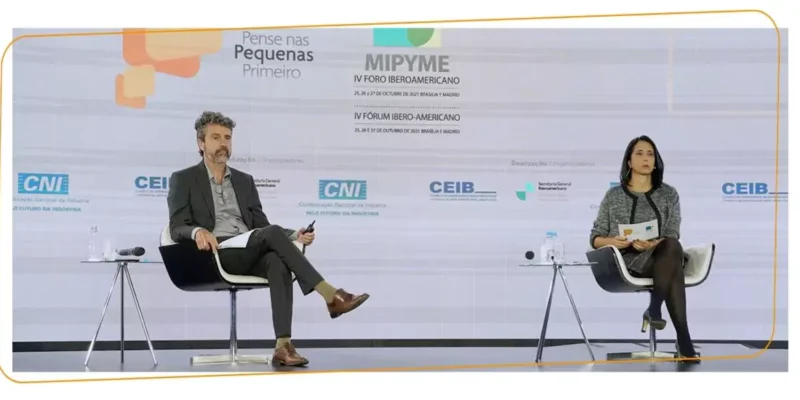
Having access to credit is important for micro, small and medium-sized enterprises (MSMEs) to maintain their activities and continue operating, especially in a period of crisis such as the Covid-19 pandemic. Aware of this, experts presented financial instruments aimed at facilitating access to lines of finance on the panel “Credit and financing for small businesses”, no Ibero-American MSME Forum - Think Small First, on Tuesday (26).
The event, which brings together representatives of governments and the private sector from Iberian and Latin American countries, has as its central theme is “Recovery and growth of Ibero-American small businesses” this year.
Check out the opinions of each panelist who took part in the second day of the forum below:
For the Undersecretary for the Development of Micro and Small Enterprises, Entrepreneurship and Handicrafts of the Ministry of Culture, Entrepreneurship and Handicrafts. Ministry of Economy, According to Fábio Silva, for Brazilian companies to be able to get back on their feet, it is important to have a healthy working environment, as well as financial conditions.
“We understand that access to credit is fundamental, but it has a much bigger context in the daily lives of these companies. It's important to have a lighter working environment, freedom to undertake in the country, generate employment and generate income in a responsible and healthy way,” explained the undersecretary, who also encouraged the formalization of individual microentrepreneurs (MEIs).
“Around 13 million people who were informal and invisible to society have become regularized thanks to the instruments we offer in an online and simplified way. That's what we're looking for: to offer a simple business environment,” said Silva, who attended the event in person at the National Confederation of Industry (CNI) studio.

Meanwhile, the president of the National Association of Credit Bureaus (ANBC), Elias Sfeir, pointed to sustainability as the “key” for companies to have different credit conditions. “If you're going to set up a company, think about sustainable points, because the tendency is for MSMEs that follow environmental standards to have more benefits when it comes to accessing lines of finance,” suggested Sfeir.
In addition, the expert encourages the renegotiation of debts between companies and financial institutions, with the extension of deadlines instead of negating a CNPJ; spoke about how the pandemic has accelerated the digital transformation and how this has impacted access to credit; and gave tips for entrepreneurs who intend to apply for credit now and in the future.
“Before taking out a loan, categorize it. ‘Do I need the credit? What do I need this credit for?’ Check other possibilities such as anticipating receivables. Check that you have a good credit rating. Draw up a business plan to calculate rates and risks of damage. Be prepared for bureaucracy, because it exists, so keep your documents up to date,” proposed the president of ANBC. “The place where you have a bank account is not always the best place to apply for credit,” he added, with the tip for MSMEs to look for the right line of financing, regardless of the institution.
Sigfrido Lee Leiva, Deputy Minister for MSME Development at the Ministry of Economy (MINECO) of the Republic of Guatemala, also pointed out that the pandemic has accelerated processes around the world. “The crisis has accelerated several reforms that were pending. On the one hand, it was good. We wanted to have the solutions and instruments we have now, before the crisis,” explained Lee Leiva.
For him, one of the obstacles that has been solved and will be definitive post-pandemic was the lack of diversification of financial instruments.
“Understanding the need to make these instruments more flexible was fundamental. Credit guarantee funds are very important for restructuring a country's economy. We want to have a better outlook for the future and for that we need to facilitate the flow of capital so that MSMEs can successfully get back on their feet. Not everything can be debt right now. We want to return to the lifestyle we had before, but under different conditions,” said the Guatemalan deputy minister.
Last but not least, the European representative of the Lafise Financial Group, Elisabeth Saavedra, defended the participation of women in the management of MSMEs around the world and the need for financial education for all.
“We need to inform people so that they are not afraid of financial institutions. Based on a survey we carried out, we noticed that women are afraid to apply for credit for fear of being cheated and paying higher rates. That's why we intend to create an initiative aimed at including women in finance,” said Elisabeth.
As a representative of the private sector, she also defended the importance of having the government's support in any and all actions for MSMEs; explained that personalizing service and putting the customer at the center is the best strategy for financial institutions, as each company has a production cycle; and encouraged people to seek to formalize their businesses so that they have access to the benefits that can help companies grow.
The panel was moderated by Juan Elorza, Director of Technical Analysis and Evaluation, Private Sector at CAF Development Bank of Latin America.
Open innovation is the theme of the third day of the forum
The panels for October 25 and 26 of the Ibero-American MSME Forum - Think Small First can be accessed on the event's website, where you can also register for the last day.
The third day will be dedicated to the Ibero-American Open Innovation Forum, held in Spain and also broadcast by InEvent. Check out the program below:
Wednesday (27/10)
10:00 - 11:00 | Panel 1 - Public open innovation initiatives
11:00 - 12:00 | Panel 2 - Venture Corporate: success stories in Ibero-America
12:00 - 13:00| Panel 3 - Development of the venture capital industry in Ibero-America